Wednesday, July 8, 2015

2015 Aston Martin Vantage - Review


The Aston Martin Vantage is the closest thing to a real sportscar offered by the British ultra-luxury automaker--the rest of its lineup consisting of exotic grand tourers. Its smallest car, the Vantage is also the least expensive Aston, but with muscular V8 Vantage models priced from about $100,000 and topping out at the V12 Vantage S's base price near $185,000, it's not what you'd call inexpensive.
For that price, drivers get one of the most exclusive sports cars on the road, one with a choice between a powerful V-8 engine and a thrilling V-12 that is one of the car world's sheer aural delights. Either is very quick, but the V-12 is downright seductive, with its fantasy-ready soundtrack.
Last year, the Vantage gained some upgrades, including a Sport mode for V-8 modes, a rearview camera, and a sport exhaust for the standard eight-cylinder Vantage. This year, there's bigger news: the V12 Vantage goes away entirely, replaced by the much more powerful V12 Vantage S model with a new transmission and adaptive suspension. There's also a new entry-level Vantage GT model--entry in price point, anyway.
All Vantages have the same profile, a suggestively low hoodline and sleek, laid-back windshield, with rounded rear haunches that have become Aston's signature since it started building cars mostly from aluminum. There's more room for air to circulate on the V12, with more intakes slitted into the hood, and it wears new 10-spoke wheels, a blacked-out roof and a black panel on its exceedingly short decklid. The cabin's carried over with Aston's crystal keyfob taking center stage, and metal and Alcantara accents framing a well-organized dash--with carbon-fiber trim on V12s taking on accent colors.
For the exterior, Vantage GT buyers can choose from a series of eye-catching liveries with optional graphics packs. Inspired by classic Aston racing cars of the past, the liveries feature two-tone paint jobs and special details for the grille, mirror caps and rear diffuser.
Aston Martin Vantage performance
The standard V8 Vantage hangs on to its 4.7-liter V-8, pegged at 420 horsepower and 346 pound-feet of torque in base trim, lifted to 430 horsepower and 361 pound-feet of torque in the V8 Vantage S. Transmissions are a six-speed manual or a seven-speed, automated manual. The V8 Vantage S manages the 60-mph run in 4.3 seconds with a maximum speed of 190 mph, while the standard V8 Vantage takes 4.9 seconds and tops out at 180 mph.
Powering the Vantage GT is a 430-horsepower version of the V8 Vantage’s 4.7-liter V-8, which can either be hooked up with a six-speed manual or seven-speed automated manual with paddle shifters. Owners can expect a 0-60 mph time of 4.6 seconds and a top speed of 190 mph.
For an electric experience without lithium-ion batteries, there's the V12 Vantage S, which replaces the former V-12's 510 horsepower with the same 565-hp, 6.0-liter V-12 found in Aston's Vanquish. Torque is rated at 457 pound-feet. The only transmission available is a seven-speed, automated manual. With its extra power, the V12 Vantage S is capable of a top speed of 205 mph and 0-60 mph acceleration in just 3.7 seconds. It has one of the best engine notes in the entire car world; if only the automated manual had the same smooth moves. It's less juddery than in other applications we've driven (Aventador, older BMW M3s), but the lurching that accompanies low-speed gear changes requires a gentle foot on the throttle. It's much smoother as speeds build in a blast of horsepower: we've seen 143 mph without stressing the big twelve in any major way.
All Vantage models exhibit crisp steering and suspension responses, with perhaps a sportier bent than you'd expect in this luxury class. The V12 Vantage S gets an all-new three-mode adaptive suspension offering Normal, Sport, and Track modes that ramp from plush to firm and agile. The suspension mode settings also tie in to the throttle, shift speed, and exhaust note to further enhance--or rein in--sportiness. (For a more detailed description of the V8 Vantage's handling, read this first drive report of the V8 Vantage S at Motor Authority).
Grippy, track-ready Pirelli P Zero Corsa 19-inch tires are standard, but for a slightly more compliant feel, P Zeros are a no-cost option. The V12 Vantage S's carbon-ceramic brakes are stupendously powerful, with some of best pedal feel--not at all grabby--of their kind.
If you're after high-horsepower V-8s and V-12s, you shouldn't expect great gas mileage--and you won't find it with the Vantage range even if you do. The V8 Vantage and V8 Vantage S rate 13 mpg city, 19 mpg highway, and 15 mpg combined with the manual transmission, and 14/21/16 mpg with the automated manual. The V12 Vantage S hasn't yet been rated.
Aston Martin Vantage comfort and features
The entire Vantage range shares similar cockpit and seating features, with low-slung but comfortable seats, a wide and relatively simple center stack, and good forward visibility. In all, it's a nice environment for sporty driving or even extended cruises, but it's not particularly roomy.
As you'd expect with a high-performance two-door, there's not a lot of room for luggage or other gear. The trunk is adequate for a weekend getaway at most, and there's very little storage in the main passenger compartment. Given the Vantage's objective--high-speed touring and sporty weekend driving--that's probably not an issue for most buyers.
Materials and finishes are generally excellent, though as with any hand-built car, you may find individual variations in some panels. Leather (Luxmill or semi-aniline), Alcantara, and metallic trim are the main staples of the Vantage cabin, with tasteful use of high-end plastics to fill the gaps. Aston's trademark crystalline key fob is also found here, plugging into the dash to become the push-button starter. We'd opt for the available carbon-fiber interior trim, which covers the center stack and door pulls in the material, even tinted if you so desire.
As is common with low-volume, exclusive sports cars, the Aston Martin Vantage range hasn't undergone crash testing by the National Highway Traffic Safety Administration (NHTSA) or the Insurance Institute for Highway Safety (IIHS). All models come standard with stability and traction control, a full complement of driver and passenger airbags, and rear parking sensors.
The V8 Vantage and V8 Vantage S come with plenty of standard features, including a 160-watt Aston Martin audio system with six-CD changer; Bluetooth; integrated iPod and USB connectivity; and a 3.5-mm auxiliary input jack. Electrically adjustable sport seats, a full-grain leather interior, organic electroluminescent displays, automatic climate control, rear parking sensors, and power-folding heated exterior mirrors are also standard. Stepping up to the V12 Vantage S brings all of those features plus standard navigation, auto-dimming mirrors, three-position memory seats, and various carbon fiber and titanium interior and exterior accents.
In addition to the strong base feature set, there are many available upgrades, plus Aston Martin's ability to personally configure your car with nearly any feature you might want--provided a large enough bank account

Tuesday, July 7, 2015

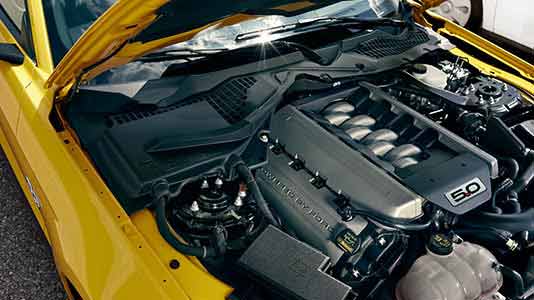
Ford Mustang

5.0L Ti-VCT V8 The new 5.0L V8 is even more powerful this year. • 435 horsepower* • 400 lb-ft. of torque* • Larger intake and exhaust valves • New intake and exhaust camshafts with increased lift • 16 city/25 hwy/19 combined mpg**
Voice-activated Navigation System The available voice-activated Navigation System includes a free five-year subscription to SiriusXM Traffic and Travel Link34 which
combines Global PositioningSystem


(GPS) technology with 3-D mapping and provides voice-guided turn-by-turn directions. With SiriusXM Traffic and Travel Link34, you’ll get detailed traffic information, plus current and forecast weather, gas station locations and prices, sports scores and schedules, and theater locations with movie listings and times.


6-Speed SelectShift® Automatic transmission with paddle shifters The available six-speed SelectShift® automatic transmission features paddle shifters on the steering wheel that enable you to override automatic operation and enjoy the fun-to- drive performance feel of a manual with control over gear selection.


RECARO® leather-trimmed front sport seats with manual adjustment (requires Ebony interior) Premium RECARO® leather-trimmed sport seats are race-inspired and deliver excellent support and comfort, even in strong lateral gs. They’re available on Mustang EcoBoost® Premium and GT P

New Mercedes AMG GT3 set for more VLN Nordschleife races


Mercedes says it will take in more races on the Nurburgring Nordschleife as part of the development process of its new AMG GT3 racer, following the car's debut last weekend. The replacement for the SLS AMG GT3 took pole position for its first race in the VLN series last weekend, with Mercedes veteran Bernd Schneider setting the best time of 8m02.897s to grab pole by 5.1 seconds. However, the car finished the race 52nd overall, four laps down due to a wheel bearing issue. The Mercedes set the second fastest lap of the race, only beaten by the Falken Motorsports Porsche 911 that finished second. Mercedes-AMG CEO Tobias Moers said: "For us, this test race at the Nurburgring Nordschleife was very important. "It is the world's most demanding race track and therefore is playing a significant role in the development of our race and road cars. "The fact that not everything is running flawlessly in the first race is something that can happen. "Nevertheless, I am very happy and this wasn't our last outing in the VLN."


Monday, July 6, 2015

2016 BMW 7 Series vs. 2015 Mercedes-Benz S-Class

The new 2016 BMW 7 Series is ready to tackle Mercedes-Benz and Audi head on in one of the most tightly contested segments on the market. Falling behind in sales compared to the S-Class, the revived 7 Series is aiming to dethrone the S-Class and take the segment crown for itself. And BMW has given the new G11/G12 all the tools do so — from a weight loss and advanced tech features to a fresh and dynamic design. When it comes to exterior design, the two limousines take a different approach. BMW continues to emphasize the driving dynamics through its design, while Mercedes goes for the massive and luxurious look that you often see on Bentleys and Rolls Royces. The front-end of the two cars cannot be any more different; S-Class’ grille takes over the entire fascia compared with BMW’s s0fter approach to the front design.
The rear end design follows the same philosophy: massive for the Benz, sportier-looking for the bimmer. BMW’s 7 Series design stretches horizontally while the S-Class stands out with its vertical approach and lots of lines.
The interior is where the 7 Series shines, being as opulent and luxurious as possible. With a lovely array of leather, wood and aluminum, the new 7 Series’ interior has a bright, comfortable and airy feel to it. The cabin tech and premium design is now more obvious than ever and it not only fares well against the S-Class, but it seems to be years ahead of any current BMW cabins. Much like the S Class, the gauge cluster has been replaced with a 12.3” screen, displaying different gauges while in different Driving Modes.
As seen in those image comparisons, the choice between the two high-end sedans is tougher than ever. Customers will likely to have a harder time picking one over the other; the S Class, in typical Mercedes-Benz fashion, relies more on its luxury car roots, while the 7 Series is more about advanced technology and has a more modern feel.

Meet The Guys Who Paid $4 Million For The Lamborghini Veneno Before Seeing It

You think you were excited about what Lamborghini was unveiling at Geneva? We talked to two of the three gentlemen who bought a Lamborghini Veneno for more than $4 million before they ever set eyes on the real thing. That's love... and a lot of faith in Lamborghini's designers. The rumor of a front-engined GT from Lamborghini at Geneva turned out to be not more than a clever distraction. Instead, we got the Veneno, and it's been a week since Mr. Winkelmann presented the prototype at Geneva, so we all had some time to think about this anniversary special. Chris Harris didn't get it, and also said that since the Gallardo is ten years old now, the warning bells are out there for Lambo. He has driven Lamborghinis before, while I haven't. But still, I respectfully disagree. The Gallardo is a very potent and good looking car even after a decade, and while a replacement is surely due, the Diablo was produced for eleven years and I'd still take a 6.0 VT SE from 2001 instead of an early Murcielago. So I'm with Travis on this. The Veneno is indeed the next poster on children's walls, and that's exactly what the two smiling men wearing Veneno pins on their jackets told us during the first two minutes of our conversation. Meet Antoine Dominic, former Ferrari customer and current owner of Lamborghini Long Island, and Kris Singh, Managing Director of Tequesta Investments from Florida. They just spent $4 million each on a car they haven't really seen apart from some renderings before putting down their deposits. But they've seen it now, and couldn't be happier.


We are clearly all fanboys at the table, the only difference is that they can buy their dream cars while Peter and I remain on the other side of the glass. Still, money was not enough if you wanted to own a Veneno. Lamborghini carefully chose the trio, and looking at the American pair, I'm beginning to understand why the factory took their money. They're in love with the brand. Antoine used to own a Ferrari F40 which scared him out of his mind, an F50 which needed a braking plan in advance, and an Enzo which was great but not too user friendly thanks to its firm suspension. He still has a Maserati MC12 and a special Bentley ISR in his garage just in case, but the fact that he became a Lamborghini dealer tells a lot. Kris is in his thirties, and not afraid to joke around a bit. He gives credit to Volkswagen for creating the best car in the world ( the Bugatti Veyron) by marrying a Beetle to an Audi TT RS. He also owned Ferraris before, and tells us that the last ones he liked were the 430 Scuderia and the 16M, but still he would choose a Gallardo Superleggera or Performante instead of those. They don't like Ferrari's new headlamps. I'm onboard.
Kris calls Lamborghini's Chief Designer, Filippo Perini a modern day Marcello Gandini, a genius in short. He also begged Winkelmann to sell him the Estoque, and will buy the Lambo SUV as soon as it hits the showrooms. But it's not just the shapes that these guys prefer to other supercar makers. They love the direct feel of the single clutch gearbox (Kris can't see why anybody would need faster shift-times than 50 milliseconds), and the raw power of the new V12. Antoine puts it this way: "When you have the best design, the best engine and the best gearbox, you have an unbeatable combination." Looking at Peter's MacBook, Kris is keen to give a high five for the old V12's firing order. He knows the numbers as he used them for codes in the past. I get my high five when I tell them how much I hate when people hide away their rare cars. They assure us the Venenos won't be hidden. Antoine will put his on display at the showroom in Long Island, while Kris will drive his around Florida as much as possible. He wants to be the guy sharing the poster car with the children on the street. The cars are in good hands. We start to talk about performance, and since they both drive Aventadors, they know the figures. Because Lamborghini is fighting for reduced weight instead of having more horsepower, 691 horses and the all-wheel drive system can take the base car to 62 mph in 2.8 seconds. They believe that's better than what the McLaren P1 or the LaFerrari can do with all those heavy electrics. If not, who cares? These guys find Veyrons soulless. They wanted "the spaceship that landed in the floor over there." And they got it. Only the color of the stripes on their cars remains a secret
Look at this rear, and imagine it with a numberplate. Michael Lock, the boss of Lamborghini North America calls it "crazy" with a big smile on his face. I couldn't agree more. Crazy is what they've been selling since the Countach, and looking at the wheel arches of the Veneno, they clearly haven't forgot about that legacy. When I tell him that it surprised me two of the three cars ended up in North America, he says he wanted to sell all three. In the end, one went to the Middle-East. Still, Europe only gets the prototype in the Lamborghini Museum, so America pretty much won this round.
I'm curious what can he tell me about future Lamborghinis, but we start with the last few years instead. Since everybody loved the Estoque concept, I'm wondering why they choose to build a SUV as the third model. Surprisingly, he says there is simply no sufficient platform at the VW Group, and before I could ask about the Porsche Panamera, he tells us that's too fat. Then he corrects it to "well-built" with another smile, but the facts remain. As he puts it, Lamborghini won't do badge engineering. So sticking Lamborghini badges and a carbon body on a Panamera chassis is not going to happen. The Urus is different, and they're just waiting for VW's green light to start. Having a better base for that, the engineers have enough flexibility to turn it into a proper Lamborghini. That means having less weight, radical styling and more power than anybody else on the market. That's the Lambo way.
We talk about China for a while, and it turns out that's the only market where Ferrari can't outsell Lamborghini like it does everywhere else. The reason is that Chinese kids neither had Lamborghini or Ferrari posters on their walls thirty years ago. Ferrari's motorsport heritage simply doesn't count in Asia, so it's all down to today's styling and performance. So let's look at those...
The Veneno might look like something that was designed by a child on LSD, but don't get fooled by that. The giant adjustable wing, that insane diffusor and the sharp spoilers in the front are all there to improve aerodynamics, meaning more downforce and less drag. Thanks to the completely new carbon fiber body and lightweight materials on the inside like the carbonskin trimming, the Veneno prototype is 270 pounds lighter than the Aventador. And the three production cars will be even lighter than that. The car also gets a modified suspension with new dampers, springs and anti roll bar to support that extra grip.
According to Lamborghini's Research and Development Director Maurizio Reggiani, every team involved in the process could finish with a happy feeling. The designers could go extreme, the aerodynamics team wasn't limited by styling, and the engineers could turn that V12 into something even mightier surrounded by the most advanced materials available. The end result is 3,218 pounds propelled by 750 horsepower. Compared to the Aventador's V12, the Veneno's has improved back-pressure on the exhaust side, retuned engine management and a brand new camshaft for higher revs. The redline is at 9000rpm while maximum power comes at 8700. All that results in a car with an electronically limited top speed of 220 mph. He wouldn't tell us what it could do without the nanny, but I guess more would be the right answer. Lamborghini will stay normally aspirated for now. That's the most responsive engine, and that's what they want from their cars. If they reach the point when regulations make it impossible, forced induction is the next step, and only when that's not enough will they turn to hybrids in their supercars. The reason is simple: low weight is the most efficient tool in the pursuit of speed, while electric systems are heavy and large. Packaging is an issue when you want perfect balance. The Urus SUV is a different story. That will be big enough for a hybrid power train, and the positioning shouldn't be a problem either. So it's not like they are living in the past at Lamborghini, they just have a strong idea of what's right for their products.

Sunday, July 5, 2015

BMW M6 Lineup Gets New Competition Package that Bumps Output to 600 hp


BMW is delivering another most welcome no-brainer: A new track-oriented Competition package for the BMW M6, which will push power and torque further into the stratosphere. The twin-turbocharged 4.4-liter now makes 600 horsepower and 516 lb-ft of torque, and is said to launch Competition M6 coupes and Gran Coupes to 60 mph in 3.8 seconds. (Figure on that being conservative; we’ve clocked the regular M6 Gran Coupe to 60 in 3.5 and 3.7 seconds.) The heavier M6 convertible should only be a couple of ticks behind in Comp trim. Top speed remains unchanged at a governed 155 mph. The boost in output reflects that made to the limited-edition model BMW produced to celebrate 30 years of the M5, which made it the most powerful production Bimmer ever. As with the previous Competition package, BMW has stiffened the springs, dampers, bushings, and anti-roll bars. The character of every electronically controlled device has been sharpened and pushed towards the edge in order to create a sportier, more raw driving experience. This includes the stability control’s “M Dynamic setting” and the active rear differential. The steering is more direct that on the base M6. While the regular M6 models are fitted with 19-inch wheels as standard, the Competition package includes two-tone 20-inch wheels and four black exhaust tips.


While pricing and the U.S. launch date are up in the air—the last one cost $7300 on coupe and convertibles, $6000 on Gran Coupes—we wholeheartedly recommend the package to the serious driver committed to buying an M6 model. It would be nice, however, if the bundle also shaved some weight from the car. Either way, it’s a no-brainer not just for BMW and its profit margins, but for customers as well.

The all-new Mercedes-AMG GT S


The all-new 2016 Mercedes-AMG GT S is an achievement of intense passion and beauty for the senses: breathtaking performance, scene-stealing looks, and a growl that intimidates the road itself. Born on the racetrack by the AMG engineers in Affalterbach, it features an all-new AMG 4.0-liter V8 biturbo engine and a 7-speed dual-clutch transmission, delivering a 0-to-60 time of 3.7 seconds (preliminary). Low bodyweight and lightning-fast power transfers mean cornering is thrillingly sharp, with the Mercedes-AMG GT S setting new standards for precise, dynamic performance. The interior is the next expression of our "aviation design" theme, featuring a powerful wing-like dashboard, four central spotlight-style vents and a dominant center console. And everywhere you look and touch, the finest materials and craftsmanship exude the quality and exclusivity that only Mercedes-AMG can provide. The all-new Mercedes-AMG GT S arrives in Spring 2015.


Key Highlights Handbuilt AMG 4.0-liter V8 biturbo engine - the world's first sports car engine with the turbos inside the V of the engine and dry sump lubrication 0-60 mph time of 3.7 seconds (preliminary); 193 mph top speed 7-speed dual-clutch transmission with electronically controlled limited slip differential AMG Dynamic Exhaust System with electronically controlled variable vane AMG Dynamic suspension AMG DYNAMIC SELECT with multiple driver selectable suspension and steering modes AMG Performance steering wheel with shift paddles High-quality Nappa leather Numerous trim options, including silver chrome, matte carbon fiber, high-gloss carbon fiber, black diamond and matte silver fiberglass Advanced safety technologies, including COLLISION PREVENTION ASSIST PLUS, Adaptive Braking technology, ATTENTION ASSIST, PARKTRONIC, Rearview Camera, and the PRE-SAFE® system Optional Lane Keeping Assist and Blind Spot Assist